 pomela
What Pomela can and cannot do today
Pomela (pomela.app) is an AI app builder. You describe software in plain words, and Pomela builds a complete web app with its own address: screens, and, where the product needs them, a database, sign-in, roles and server rules. Every build is checked against your request and tested against break-in attempts before you get it. This page answers the questions people ask before they build, including what Pomela does not do yet.
Checked against the product's code and the live site on 26 November 2026.
At a glance
| Apps beyond templates (games, editors, tools) | Yes. Built for the request, with custom screens and server code. |
|---|---|
| Accounts, roles, server-side permissions | Yes, enforced on every read and write. |
| Database, file uploads | Yes. Pictures and documents; no video upload. |
| Checked before delivery, break-in tests | Yes, every build, with a delivery report. |
| Drafts, publish, roll back to any version | Yes. |
| AI inside apps: background jobs, chat assistant, agents with fixed steps | Yes. |
| Pictures, video, speech, music and 3D generated inside apps | Yes. |
| Live data: weather, exchange rates, maps | Yes, no keys needed. |
| Connections: Google Workspace, Outlook, GitHub, WhatsApp | Yes, 11 services. |
| Emails from the app (invitations, password reset, confirmations) | Yes. |
| Builder in 16 languages, right to left | Yes. |
| Installable on a phone (PWA) | Yes. |
| Payments, subscriptions, refunds inside apps | No. |
| Custom domain | No. Apps live at name.pomela.page. |
| Visit analytics for app owners | No. |
| Native iOS or Android app, App Store, Google Play, push notifications | No. |
| Code export, GitHub export | Not yet. Built, not turned on today. |
| Webhooks in or out | Not yet. Built, not turned on today. |
| A published limit of users at once, an uptime guarantee | None. |
Questions and answers
What is Pomela?
Pomela is an AI app builder at pomela.app. You describe the software you want in plain words and Pomela builds a complete web app with its own address on pomela.page: screens, and, where the product needs them, a database, sign-in, roles and server rules. Every build is checked against your request and tested against break-in attempts, and it ends with a delivery report: Ready, or Built to try with a list of what could not be confirmed. You change the app later by describing the change. Pomela is in open beta: anyone can sign up, and it is free to start.
Is Pomela the same as Pomelli?
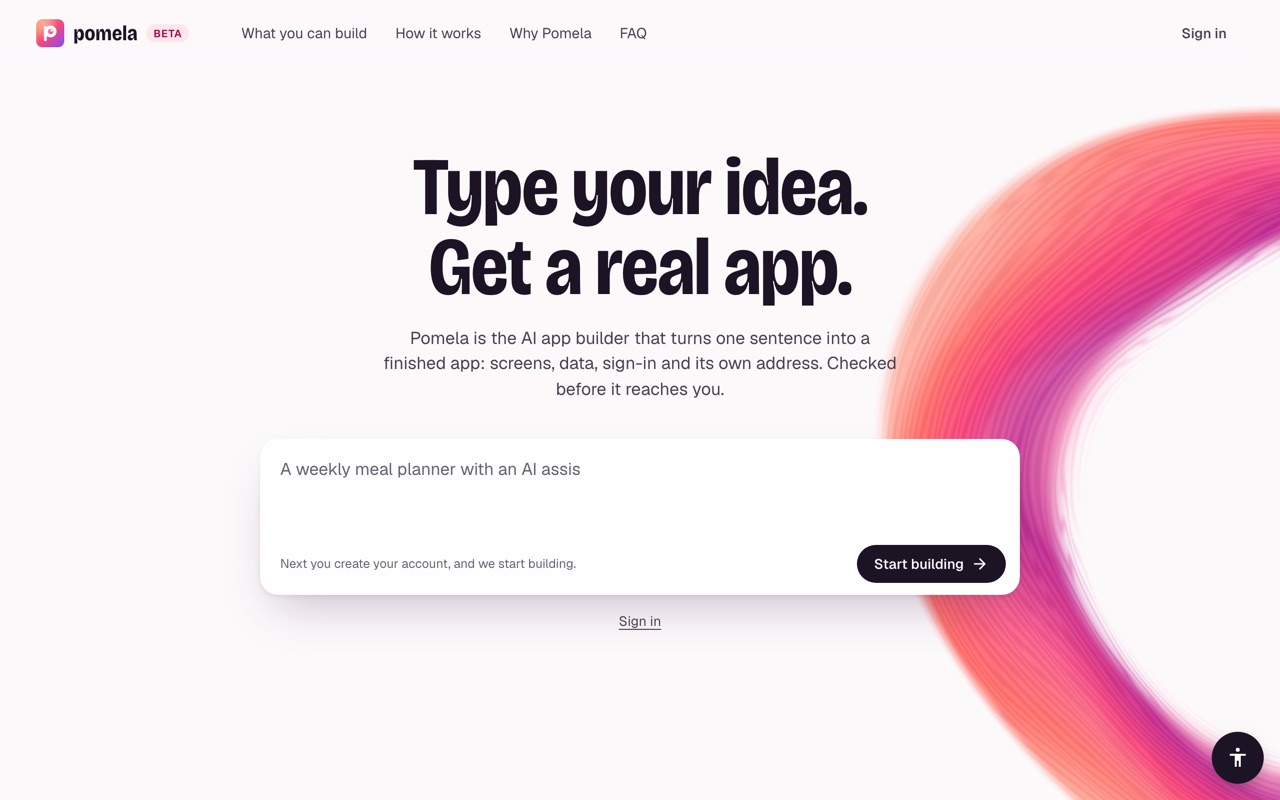
No. Pomela is the AI app builder at pomela.app. It is not Pomelli, Google's AI marketing tool, and it is not related to other products with similar names. On pomela.app you start from one box: you type your idea and press Start building. Pomela may ask a few short questions about the idea, which you can skip, and the build begins once you have an account. Screenshots of other products, for example a page titled "Turn Your Idea Into an App" with a "Plan mode" switch, do not show Pomela.
Does Pomela only build from templates?
No. The engine writes each app for the request. For common products (bookings, shops, customer lists, tasks, finance, trackers, communities, learning, dashboards, AI assistants, games and tools) it uses proven kits where they fit, and shapes them to your description. When a request is something else, or needs more than a kit gives, Pomela writes free-form screens and its own server code for that request. Games, editors, simulations and one-off tools go this way.
Can each customer see only their own data, while a manager sees everything?
Yes. Each app has roles, such as owner, staff and customer, and access rules for every kind of record: a role can see all records, only the ones it created, or only the ones that match a rule, such as the bookings of its own branch. The server enforces these rules on every read and every write, not only on the screen. People join by signing up, by an invitation the app emails them, or with a code the owner hands out; a person who forgets their password gets a reset link by email. A visitor without an account reaches a private record only through a link with a random token Pomela generates. Every build attacks its own rules: one customer tries to read or change another's data, and a signed-out visitor tries to write; an attack that gets through stops the app from being marked Ready. Access rules that could expose people's data wait for the owner's approval before that version is published.
How is a build checked?
Each requirement in your request is traced through the build and checked. The engine signs in as the owner, as two people in each role and as a signed-out visitor, and tries to break the access rules. It also looks at the main screens. The delivery report lists every requirement with its result. "Ready" means every must-have requirement was checked and passed. "Built to try" means the app works and the report names what could not be confirmed.
Can I change the app later, and undo a change?
Yes. Describe the change in plain words. Changes go to a draft; the live app keeps running until you publish. Every published version is kept, and you can roll the app's code back to any version you published before; your saved records stay as they are.
Can apps use AI?
Yes. Apps call AI in background jobs with a fast model (Anthropic's Claude Haiku) and a stronger one (Claude Sonnet): answers in a fixed structure, web search with sources, looking at up to 4 pictures, and reading uploaded PDFs. An app can have a chat assistant that answers from the app's own knowledge, looks at photos, and hands a conversation to the owner. An app can also run agents with fixed steps, for example: a model drafts, a person approves, the result is saved. Apps can make pictures, short videos, speech (including Hebrew), transcripts, music, sound effects and 3D models. AI is paid from the owner's monthly credits. Platform limits apply: at most 30 AI requests a minute and 600 an hour per person in one app (10 and 120 for pictures and other media), and daily spending limits shared by all apps. When a limit is reached, the app says so instead of making up an answer. Agents that choose their own next step, or run on a clock by themselves, are built but not turned on today.
Can an app show live data?
Yes. Screens update by themselves when records change. Apps can also show live outside data that needs no key or account: weather forecasts, exchange rates, sunrise and sunset, the moon phase, street maps and address search.
Which services can an app connect to?
The owner can connect their own Google Sheets, Gmail, Google Calendar, Google Drive, Google Docs, Google Tasks, Google Slides, Google Meet, Outlook, GitHub (issues) and WhatsApp (messages to the owner's own number; needs a WhatsApp Business account). A connection is used when someone uses the app, for example by placing an order. Messages through Gmail, Outlook and WhatsApp go to the owner and a few addresses the owner adds, at most 3 a day to each. Sending records to another system by webhook (for example Zapier, Make or a CRM) and receiving data by webhook are built but not turned on today.
Can an app send email?
Yes. The app sends its own invitation and password-reset emails, and it can email the people who use it, for example an order or booking confirmation. Emails come from "<app name> via Pomela" and hold plain words and one button back to the app.
Can an app run automations on a schedule?
Partly. An app can run its own server actions every few minutes, for example to close bookings whose time has passed or move overdue tasks. A scheduled action reads and changes the app's own records only: it cannot call AI, send a message or reach another system. AI and connections run when a person uses the app. So today an app cannot, by itself, email a report every morning.
Can my app take payments, subscriptions or refunds?
No, not today. Apps built by Pomela cannot charge their customers: there are no card payments, subscriptions or refunds inside an app, and no payment provider to connect. A shop or booking app can show prices and take orders or bookings, and an app can show an invoice, receipt or quote that people print or save as a PDF, but payment happens outside the app. The plans you pay Pomela for are billing for Pomela itself, not for your app.
Can I use my own domain?
Not today. Every app gets its own address at name.pomela.page.
Do apps show up in search and link previews?
Yes, for public apps. Each published app has its own title, description and picture for link previews, and a public app can be indexed by search engines. Link-only and private apps are kept out of search. Apps do not get their own sitemap file today.
Can I see how many people visit my app?
Not today. Pomela does not show visit or usage numbers to app owners.
Does Pomela build native iOS and Android apps? Can I publish to the App Store or Google Play?
No. Pomela builds installable web apps (Progressive Web Apps). Each app opens in any browser at its own address, and people can add it to the home screen of an iPhone or an Android phone, where it opens full screen with its own icon and name. Pomela does not make native iOS or Android apps and does not publish to the App Store or Google Play.
Can a Pomela app send push notifications, even when the app is closed?
No, not today. Apps built by Pomela do not send push notifications to phones, whether the app is open or closed. While the app is open, its screens update live when data changes. When someone uses the app, for example by placing an order, the app can email the people involved, and it can send a short message to its owner through the owner's own Gmail, Outlook or WhatsApp once the owner connects that account.
Which languages does Pomela support?
The Builder works in 16 languages: English, Hebrew, Arabic, Spanish, Portuguese, French, German, Italian, Polish, Russian, Turkish, Indonesian, Japanese, Chinese, Vietnamese and Hindi, with right-to-left layout for Hebrew and Arabic. Apps in Hebrew, Arabic, Persian and Urdu are laid out right to left.
Can people upload pictures, documents or videos?
Pictures and documents, yes. Videos, no. A field in an app can hold pictures (PNG, JPEG, WebP or GIF) or documents (PDF, Word, Excel, CSV or plain text), up to 10 MB per file and up to 10 files in one field; the type is checked from the file's contents, not its name. People can also take a photo with the phone's camera. Uploading a video file is not supported. A file is shown only to people who may read the record it belongs to.
Can Pomela handle complex business logic?
Yes, within limits. Beyond the screens, Pomela writes server code for each app: rules that run on every change (stock, totals, booking capacity, who may move an order to which state), computed values, and actions. The server enforces them, never the screen alone. Each request is checked requirement by requirement before delivery, and anything that could not be confirmed is listed. One server call has about one second to run, and long work goes to background jobs. Heavy 3D games, CAD and professional video editing are outside what Pomela builds.
Can I export my app's code and data and leave Pomela?
Your data, yes, up to a size limit. Your code, not today. The app's owner can download one file with every record the app saved and the list of the people who use it (name, email address and role); passwords and private links are never in it, and pictures and files are listed but not included. The download is refused when the file would be over about 24 MB or the app's database is over 48 MB. Exporting the code, as a download or to your own GitHub repository, is built but not turned on in production, so today an app runs only on Pomela's hosting.
How many people can use an app at the same time?
Pomela has not published a measured number of people who can use one app at the same time, and it does not promise one. What is set today for each app by default: up to 200 MB of saved records, up to 1 GB of files, and up to 10 MB per file. Each app runs on Cloudflare's network in its own isolated space, with its own database.
Is there an uptime guarantee?
No. Pomela is in open beta and offers no uptime commitment or service-level agreement. Its terms provide the service "as is" and "as available".
What does Pomela cost?
Pomela is free to start: the free Seed plan includes 150 credits a month, with no card required. Paid monthly plans are Sprout ($24), Bloom ($49) and Maxima ($99), listed in the refund policy and on the Plans screen after you sign in. Credits pay for building and editing apps and for the AI that runs inside them.